

Hi,
Welcome to August’s look at all things true and false as revealed by the words people choose.
I hope things are good with you! Here in the UK, we’re having what feels like the sixth heatwave of the summer. As someone who loves getting outdoors whenever I can, it’s a vast improvement over our regular slightly grey, often wet summers.
Opening Question
One of the most reliable tells that a subject is causing someone stress is when they fail to provide a direct answer to a question they’ve just been asked. It’s fun to spot, but we should also keep in mind why it happens: the truthful answer won’t play well for them, so they resort to the painfully obvious tactic of answering a completely different question instead.
So, what do you think the truthful answer is to the question asked here?
We’ll find out at the end of this issue.
The Clancy Trial
By a large margin, the most popular request in my DMs this month has been to look at the trial of Lindsay Clancy, specifically, the words of her husband, Patrick.
I haven’t watched any of the trial yet, but based on the messages pouring in, while Lindsay stands accused of killing her three children, many feel Patrick’s statements warrant a closer look.
I loved this question I received about something he said:
“Hi Jack, when it was reported that the husband said “she killed the f’ing kids” it felt weird, not because of the swear word but its placement. It wasn’t “she f’ing killed the kids” where the placement would be on Lindsay but the f’ing was put on the kids. Do you have any thoughts”
I had to think about this one. It initially concerned me that the expletive sat right next to “the kids.” Generally, the closer two words sit in a sentence, the closer they are linked in the speaker’s mind.
For example, “She likes to do many of the same things I like to do” depicts a much more distant relationship than “She and I like to do many of the same things.” They use almost the exact same words, but the proximity of “she” and “I” in the second version signals a far tighter bond than in the first, where the two pronouns sit at opposite ends of the sentence.
However, I don’t think that principle applies here. Instead, it comes down to personal definitions and what the speaker internally interprets “f’ing” to mean. With a swear word like that, the meaning is fluid.
If he had said, “It’s the f’in kids at the door again,” the modifier would convey a derogatory feeling toward the children. The core information, that kids are at the door—remains fully intact without the profanity: “The kids are at the door again.” Thus, the expletive is inserted purely to express irritation caused by the children. In that context, the speaker’s internal definition of “f’in” reflects annoyance and an unfavorable view of the kids.
Now, back to “she killed the f’ing kids.” Does that also carry an internal definition of annoyance with the children? It could, but notice what happens when we replace the kids with a less emotive object.
If he had said, “She stole the f’ing money” or “She’s wrecked the f’in car,” would we assume the profanity denoted a hatred for the money or the car? I don’t think so. In those instances, the word emphasizes the magnitude of the incident and deep resentment toward what “she” did.
Therefore, “she killed the f’ing kids” doesn’t necessarily indicate hostility toward the children; rather, it conveys the immense magnitude of his horror over the action “she” took.
Great question.
Toxic 911
Thank you to Birhan, who watched A Toxic Love Story on Netflix and sent over his analysis of a 911 call featured in the documentary. I’m going to share several of his observations here. I should point out that Birhan is from Turkey, and English is not his first language. I couldn’t even contemplate analyzing statement analysis in a foreign language!
Here is the transcript of the call:
911 Operator: What is your emergency?
Angela: Somebody came from behind me and shoved me against my wall and started to choke me and were telling me I’m gonna fucking get it and it’s time for me to get raped
911 Operator: Okay. How many individuals were there?
Angela: Just one, and he was wearing a black thing over his face
911 Operator: Like a black ski mask?
Angela: Yes
My immediate takeaway upon reading this was that the caller, Angela, seemed primarily focused on establishing that she could not provide a description of her “attacker.”
She opens with “somebody,” which is completely unnecessary. If you’ve been attacked, it’s obvious that “somebody” did it. Yet her immediate priority was highlighting this unknown “somebody,” rather than the fact that she was currently in danger.
Normally, I would expect a caller to lead with their primary personal emergency: “I’ve been attacked!” But her focus isn’t on her safety; it’s centered on the assailant.
Next, and still before stating that she has been assaulted, she adds that they “came from behind me.” In the context of an urgent 911 call, she is immediately signaling, “I didn’t see this person because they came from behind.” Rather than prioritizing urgent aid, she is busy establishing an alibi for why she cannot identify anyone.
When asked how many individuals were involved, she answers “one,” but then immediately adds unprompted that “he was wearing a black thing over his face”, once again reinforcing that she cannot identify him.
Notice, too, the absence of any explicit plea for help. She doesn’t request medical aid, ask for police protection, or demand that they catch the intruder.
There is also a physical inconsistency in her narrative: the intruder supposedly came from behind, shoved her against a wall, and then choked her—a sequence that is mechanically difficult to execute from behind.
Birhan also noted that her delivery felt scripted—a step-by-step recitation of alleged events rather than an authentic, panicked plea for assistance.
Finally, Birhan caught a classic application of my favorite deception-busting word: “just.” As he rightly pointed out: if you had genuinely survived a violent assault, would your instinct in that moment be to minimize the assailant by describing them as “just one”?
I haven’t watched A Toxic Love Story yet, but based strictly on this transcript, my assessment is that Angela staged this event and fabricated the call to frame an imaginary attacker.
TikTok Shock
Another frequent request recently has been to cover Elizabeth Teckenbrock. She went viral as the “Cupcake Mom” after posting a tearful video of herself baking her own birthday cupcakes as a struggling single mother.
What began as a massive wave of public sympathy quickly turned sour amid a flood of allegations that Teckenbrock had a long history of deceptive behavior and financial scams. Her ex-husband stepped forward after seeing the video, stating that it was a total distortion of reality.
At the time of writing, she appears to be negotiating a plea deal following charges that she faked a cancer diagnosis to defraud donors out of money.
While I couldn’t source enough of Teckenbrock’s full statements to conduct a complete analysis, my attention was caught by the original caption on that viral video.
Take a look at the caption. What stands out to you?
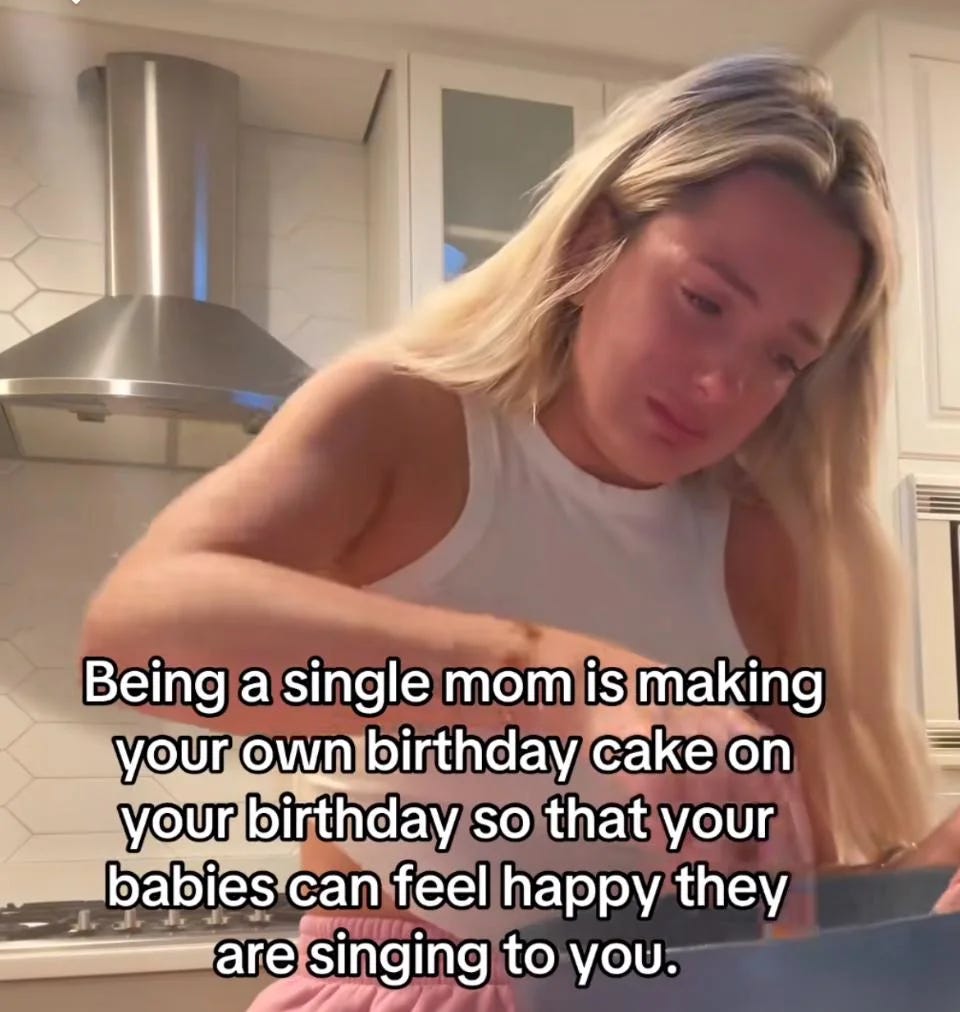
Not once does she explicitly state that she is a single mom. She hints at it, but she avoids committing to the claim with personal pronouns. Writing “Being a single mom is...” is a general statement about a concept, not a direct statement about her own life.
Furthermore, she doesn’t refer to her birthday or her babies; she phrases it as “your birthday” and “your babies”. She’s distancing herself from ownership once again.
It would have been seamless to write: “I’m a single mom making my own birthday cake so my babies can sing to me.” But she didn’t.
That detachment was red flag number one.
Finally...
Back to the politician from our opening clip: what was her truthful answer?
It probably won’t surprise you to learn she didn’t win the election!
Until next time,
Jack