

Welcome to the first newsletter of 2026, where we delve into the truth hidden inside the words others use.
It seems like no time at all since I was writing this newsletter from a warm balcony on a Spanish island. Today, you find me and the dog under several blankets after a bitterly cold night!
TOWN HALL TINKERING
Erika Kirk has been getting a lot of attention lately, and she grabbed mine with how she answered a question during her recent televised town hall appearance. Have a look at her response:
This is a beautiful example of how to avoid answering a question. It’s clear she doesn’t want to condemn Trump; let’s look at the tactics she uses to deflect.
Q: Will you condemn the violent rhetoric of Donald Trump, the most powerful and influential person on earth?
This is a yes/no question, and anything other than a “no I won’t” or a “yes I do” indicates a non-answer. Erika doesn’t disappoint. She says:
(pause) I appreciate your question (long pause) you know my heart, why would I ever say ‘yes’ go murder people
She starts with a classic bit of politeness, designed to ingratiate herself with the questioner and buy herself thinking time to form an answer that feels safe.
She then provides some social proof with “you know my heart” and asks a question rather than providing an answer. She has moved the topic of conversation away from Donald Trump (a sensitive subject) and toward her own character.
So many moves in just over 20 words!
Erika then decides to take more control by politely but forcefully deciding that the question is a bad one, opting instead to provide some words about family, a much more general topic that the one she was asked about.
I share this not to “call out” Mrs. Kirk, but because it is a great learning opportunity. It clearly shows the tactics manipulators use to take control of a conversation:
Politeness
Social proof (“I’m a nice person!”)
Evasion (Moving to a topic that feels more secure or aligns with her goals)
A switch from the specific (Trump) to the general (family)
Look at the distance she creates from the original question—in thirty seconds, she’s gone from talking about Trump to talking about family values.
I saw this same technique during my recent look at Todd Kendhammer. He was asked by police about his car journey with Barbara, which led to his alleged fatal accident.
He started with the specific, saying, “we left our house… maybe 7.30” and then went strangely general, saying, “we always just talked (in the car)” and “she always takes the thing in the car.”
His deflection was much more subtle than Erika’s, but it was a sign he didn’t want to talk about that specific car journey.
Regulars will note he also used the word “just,” which should red-flag possible deception immediately.
As one viewer tells me…

A RAMSEY REMINDER
A recent look at Burke Ramsey’s words provided a useful reminder to always check the reasons why deceptive language appears.
This was the passage that caught my interest:
Dr. Phil: Well, a 911 call with your mother hysterical about your sister being kidnapped would seem to me to be a standout experience in one’s life. I wouldn’t think that would fade into the background.
Burke: Oh yeah, no, absolutely not. I mean, that’s something pretty big that I would remember. So I just -- I wasn’t there.
Dr. Phil: So you can say with absolutely certainty that that is not your voice on that 911 tape?
Burke: Absolutely not.
Those “absolutely not”s, along with the “just,” jumped out at me. They appeared very close together and are typical words used in persuasion and deception.
It’s easy to look at that and say, “He’s lying,” but it helps to take a step back and ask why he’s using those words.
It’s fair to conclude he really wants to persuade us he wasn’t there for the 911 call, given his use of “absolutely not” rather than a simple “no.” He also uses “just” to minimize his absence.
This could be because he is lying and feels the need to make his words work harder to strengthen the lie. However, it could also be that he is telling the truth and this is a sensitive, stressful matter; for his own sense of security, he feels he must persuade us he wasn’t there.
The more words we analyze from a person, the closer we can come to accurate conclusions.
ANALYZING MYSELF
My audience often says they worry about sending me a comment in case I analyze it, but this week I caught myself analyzing myself!
I had sent my friend my ID photo (long story!), and he replied, “You look like a serial killer.”
I wrote my reply as “I can’t say I disagree,” then deleted it and sent “I agree.”
Why? I much prefer clean, positive statements, so the double negatives of “I can’t” and “disagree” were replaced by something simpler and more amenable.
My analysis was: Why were my instinctive words “I can’t say I disagree”? Because disagreeing was my wish. I don’t want to look like a serial killer! (It is a terrible photo, though.)
The way our thoughts are revealed through our word choices will endlessly fascinate me.
As an aside, I took the mention of a serial killer as a good sign, given the title of the first episode of my podcast, which was released two days after that comment!
A SAD STORY
I noticed a strange contradiction in the words of Rosario Olmos, the mother of Camila Mendoza (who was missing at the time).
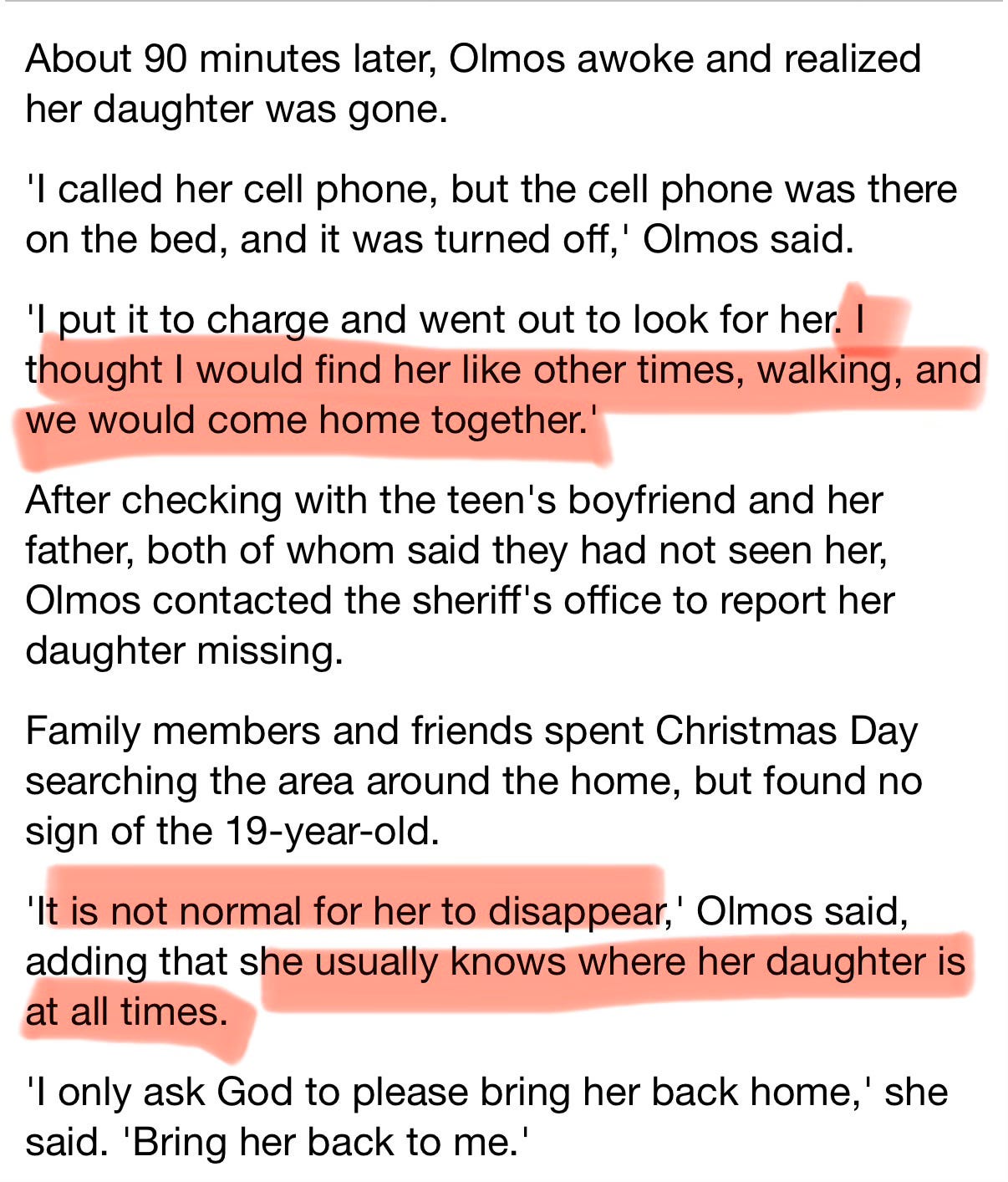
The phrases “it’s not normal for her to disappear” and “I thought I’d find her like other times” suggested to me that something deeper was going on. “Not normal” leaves the door open to it being possible Camila did disappear at times, but it worded to sound like she didn’t. Mention of “other time” made me think Camila did have a trait of going missing.
Nothing else Rosario said made me suspicious, so why that formation of words?
Deception is often intended to protect, and I thought it likely that this was a case of a mother wanting to keep quiet about her daughter’s mental health issues. Sadly, Camila was found dead shortly after this.
As sure as night follows day, when someone goes missing, internet sleuths will scrutinize the loved ones—often poorly. In Camila’s case, her recent ex-boyfriend came under the spotlight for no reason other than it “fit the pattern.”
However, he gave an interview and said this:
“I’ll be here all day… We’ve been here for three days, going on four days straight, and we’re not going to stop until we find her.”
The phrase “until we find her” is reassuring. It’s something the guilty often slip up on, saying versions like “I’ll never stop searching” or “I’ll be looking for her for the rest of my life.” These indicate the person has no hope that the search will bear fruit.
LACK OF PRONOUN, LACK OF COMMITMENT
Let’s turn to less serious matters. What do you make of the words of this person who doesn’t want to do more work (in the blue bubble)?
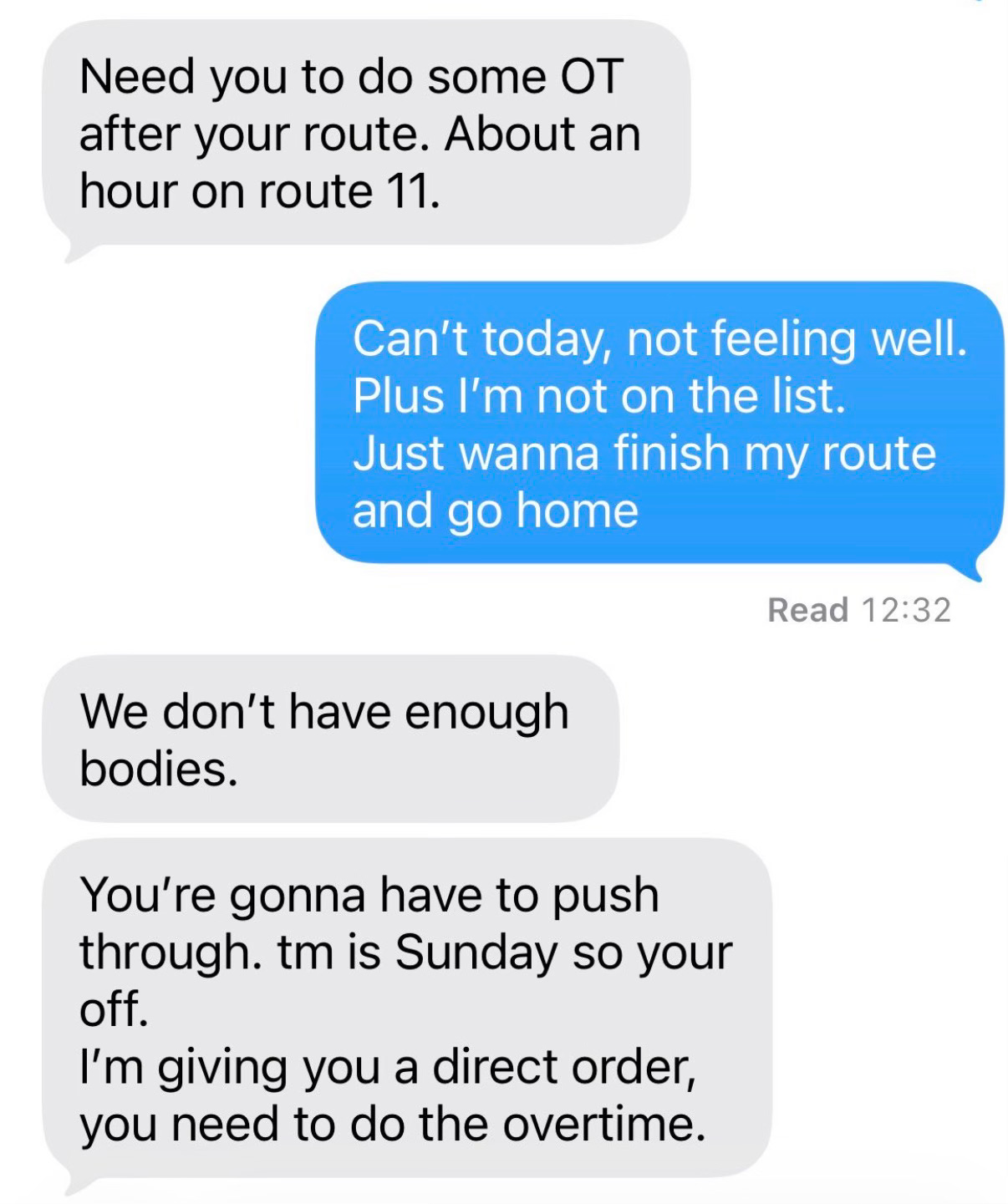
He doesn’t “own” the fact that he can’t work today or that he feels unwell. He attaches no “I” pronoun to those statements. If he’d said, “I can’t today, I’m not feeling well,” it would signal ownership and commitment to what he was saying.
You’ll notice he does use pronouns for “I’m not on the list” and “my route.”
My conclusion: He isn’t on the list, doesn’t want to work more than his assigned tasks, and is using an excuse of feeling unwell rather than sharing his grievance that he shouldn’t have been asked to do more.
NEVER THE END
I spent most of last week worrying that I didn’t have anything for my series showing people using “never” when they mean anything but.
Then, I stumbled on this while looking at Erika Kirk talking about New York.
“When I lived out here… I never dated here”.
Let’s look at the veracity of that “never.” In 2018, she filmed episodes of the dating show “Summer House,” which included her going on at least one date in New York.
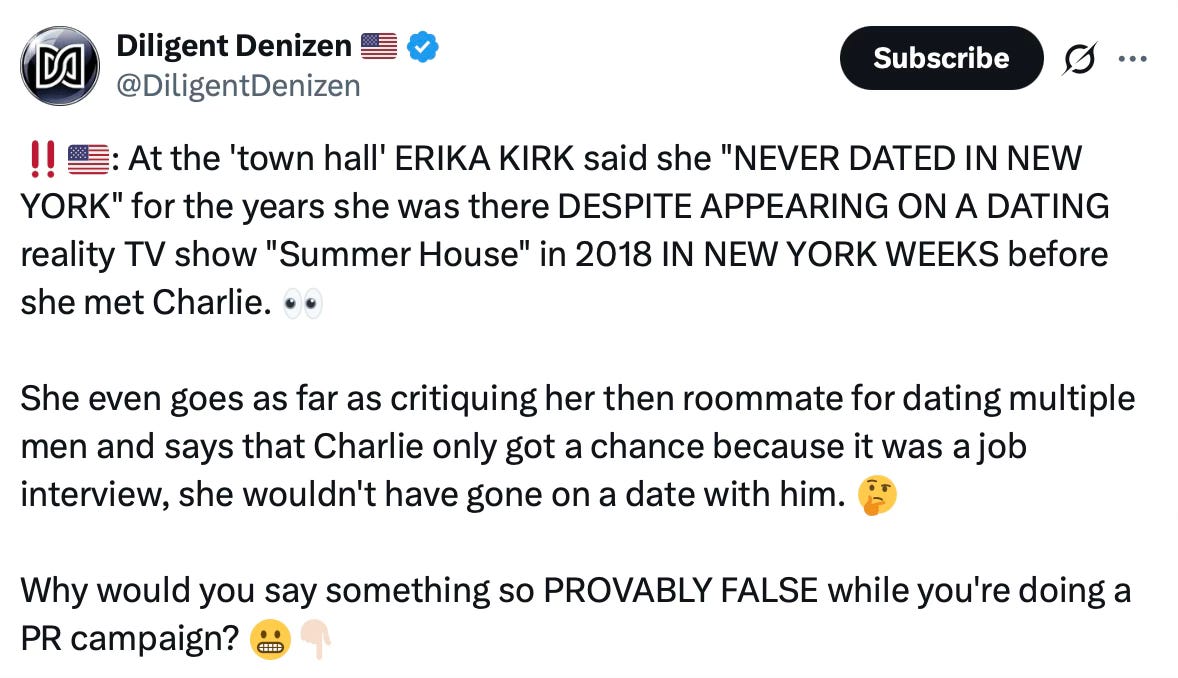
Never trust “never”
More next month!
Jack