

Welcome to June’s newsletter, where we are looking at all we can learn from the specific words people choose to use.
BFF Update
You’ll remember in May’s newsletter I recounted my conversation with Casey Anthony and predicted that the book she claimed to be writing wouldn’t materialize. Well, she has surprised me and appears to have shared the first chapter with her Substack subscribers! Being generous, that’s a rate of one chapter a month. At that speed, it could be a couple of years before they get the full book. That’s one expensive book!
She did promise the full book would be available this summer. Let’s see…
Kouri Richins Communications
A few weeks ago, Kouri Richins was sentenced to life for the murder of her husband, Eric. Kouri has been busy while locked up, as we found out when court documents reproduced a text message she sent to an “admirer.”
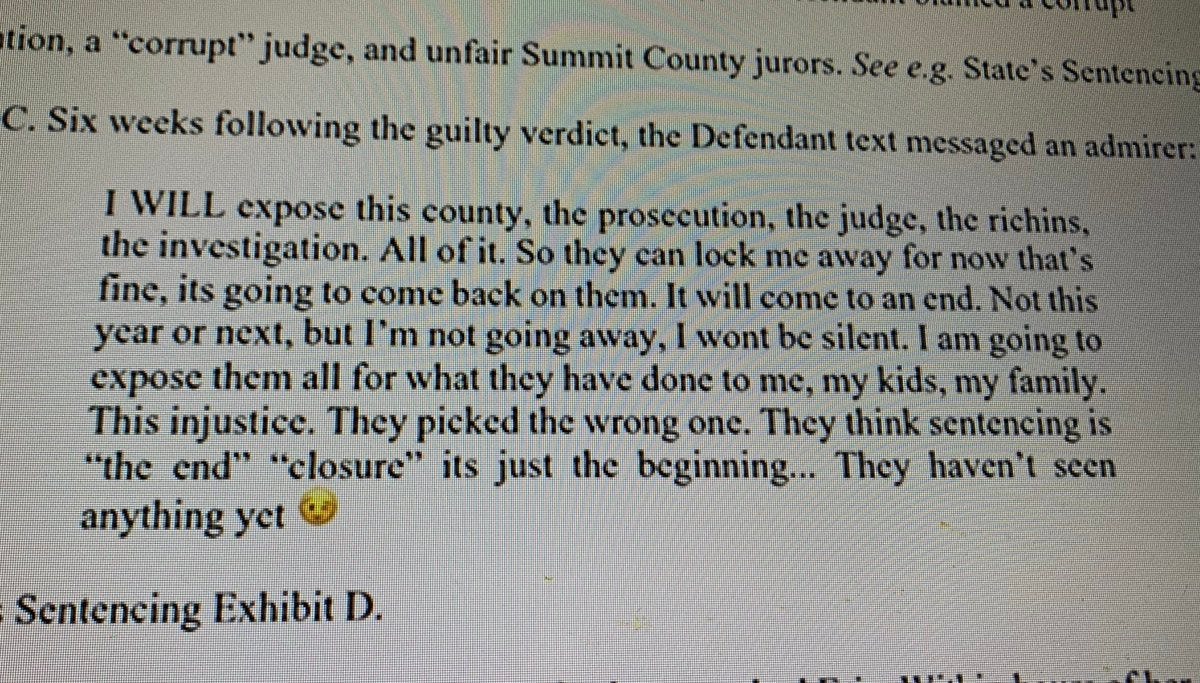
It says: “I will expose this county, the prosecution, the judge, the richins, the investigation. All of it. So they can lock me away for now that’s fine, it’s going to come back on them. It will come to an end. Not this year or next, but I’m not going away. I won’t be silent. I am going to expose them all for what they have done to me, my kids, my family, This is injustice. They picked the wrong one. They think sentencing is “the end” “closure” it is just the beginning… They haven’t seen anything yet”
This was sent to the admirer (who is that person?!) after she was found guilty. The first thing I noticed about it was that the idea expressed inside is the exact same mindset that got her locked up: I will deal with those I feel have transgressed me and are getting in my way.
The phrase “it will come to end” reflects exactly what she did to Eric when he displeased her.
For all the big talk, you can see in her words that being imprisoned is weighing heavily on Kouri’s mind. The phrases “lock me away”, “I’m not going away”, “sentencing”, “the end” and “closure” (as in cell doors) all suggest that Kouri is well aware life as she knows it has changed forever.
Furthermore, there’s no depth provided to her threat to “expose” that big list of people. “I’m going to expose them all for what they’ve done to me… this is injustice” might sound grand, but without any inkling of what it is she will expose, it lands pretty empty.
Finally, look at where Kouri’s focus lies, which is entirely on herself. If there truly were an injustice and the wrong person had been convicted of Eric’s murder, then for the sake of her children and herself, the truth about what killed Eric would need to come out. However, that isn’t expressed in her words. Her focus remains on herself and “exposing” those who have wronged her, rather than on getting to the truth and giving Eric’s family the answers they deserve.
Did I say finally? One more thing I noticed missing is that she doesn’t say that once she exposes everyone she’ll be a free woman. In other words, she plans to be a loud nuisance in jail, but knows fine well that’s exactly where she’ll be staying.
Brotherly Back Up
Still, at least Kouri has her family on her side, right? Well... here’s a letter her brother sent to the press after her sentencing.
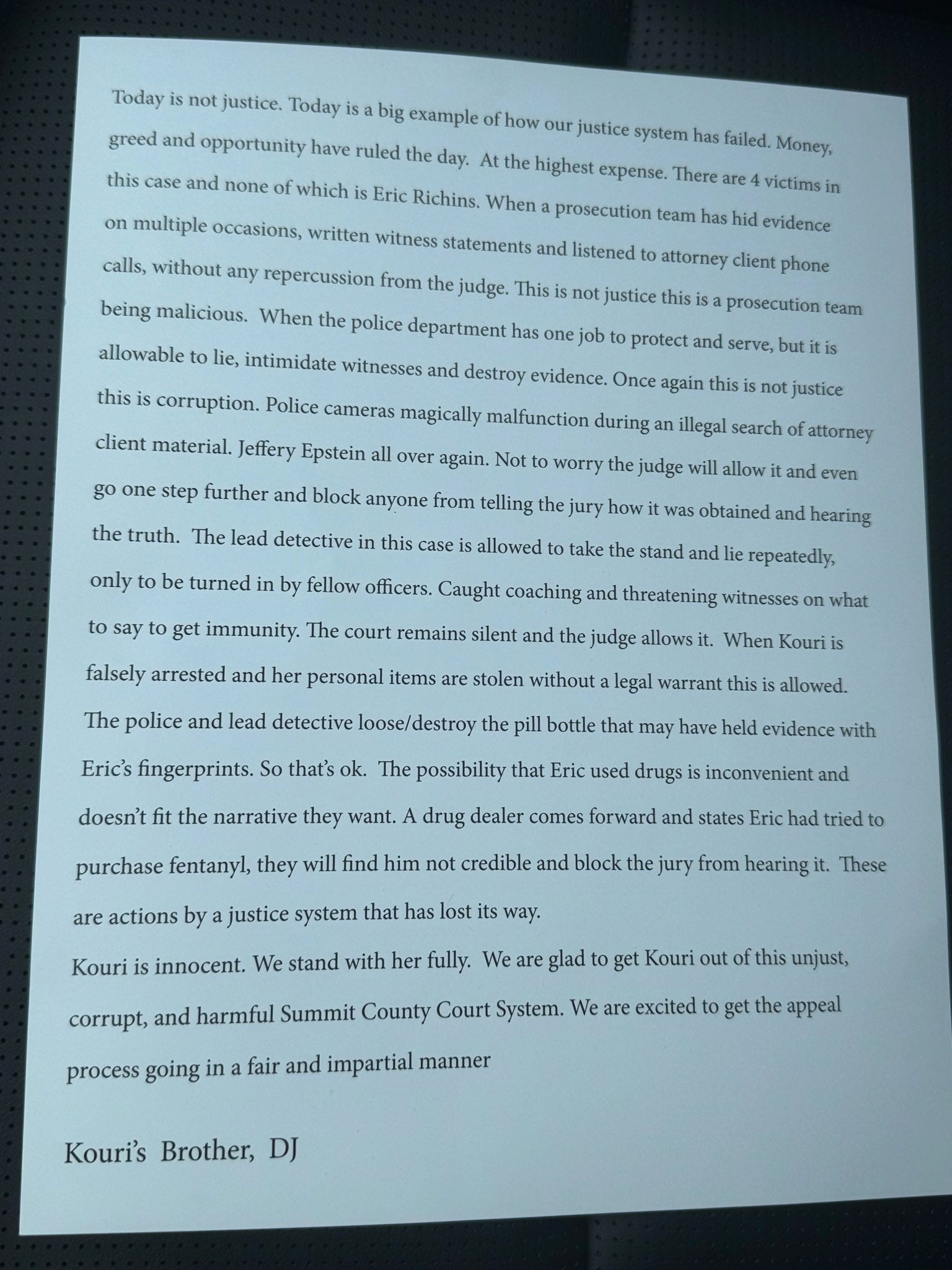
His words read just as deeply as Kouri’s, which is to say, not much at all.
On a first read, you might get the impression he’s accusing the team that prosecuted Kouri of hiding various pieces of evidence. On closer inspection, he doesn’t. “When A prosecutor team has hid evidence” and “this is A prosecution team being malicious” are concepts about a notional prosecution team; they are not direct accusations about the prosecution team.
It’s the same when he writes about the police; he doesn’t make direct accusations. Instead, it’s all abstract concepts like “when the police department has one job to protect and serve but it’s allowable to lie”.
He only gets direct when mentioning the lead detective, writing about him lying on the stand.
Her brother then lists some of the evidence that he feels exonerates Kouri. Once more, on first read, you might think, “Oh, that may have changed how I thought about this.” But I don’t think her brother believes that strongly in this evidence himself. Look at the way his choice of words weakens what he’s stating:
“The pill bottle that MAY have held evidence”
“The POSSIBILITY Eric used drugs”
The bombshell hidden evidence that could free his sister turns out to be something that maybe had fingerprints on it and a theory that was a possibility. Hardly a smoking gun.
In conclusion, the brother is saying the things he feels he should say. But when we do that, especially when we don’t write from an authentic place, it always shows up in the words we use.
Someone who passionately believed in their sister’s innocence would slam the prosecutors, tell us directly what lies the police told, and firmly state the evidence that clears Kouri. This letter was not that.
Do You People Please?
Are you like Kouri’s brother? Are you a people pleaser who often says what you think people want to hear rather than what you truly believe?
In July, a couple of episodes of my How Words Work podcast will look at how saying what you think you should say, rather than what you want to say, can make you sound hollow. I’ll also look at how you can remove that trait so you can talk with more authority and credibility.
Jermaine Jenas: Footballers Fess?
The World Cup started this week, and here in the UK, the most talked-about footballer isn’t even at the tournament. That’s quite an achievement. Step forward former footballer and TV presenter Jermaine Jenas. He gave an interview to morning TV which is going viral and mostly being referred to as a car crash.
Jenas was at the center of a scandal a couple of years ago when multiple women who worked with him on TV shows alleged he was sending them inappropriate messages. He was asked about this in the interview, and it’s fair to say he didnit deal with it well. Have a look:
Those watching felt it went badly for him. While some people likely noticed specific things he said or tactics he used, many will have simply felt that “something is off here.” I believe our brains warn us when someone is talking in a way that doesn’t add up, and in Jermaine’s case, it would be very wise to listen. Look at all the labels we can put on what he said:
“Q: Do you recognise that you were in the wrong?”
“Jenas: A hundred percent, yeah.”
A simple “yes” would be enough here, or perhaps a more expressive, “yes, I recognize I was wrong.” Instead, Jenas reveals a need to persuade us and manage our perception of him. He doesn’t just say yes; he tells us it’s a total, 100% yes.
“Q: In what way?”
“Jenas: Well, in the way that I was in a position of power in my role, in my job, and it was something that I shouldn’t have been doing.”
In his answer, Jenas starts with “well,” which is usually an indicator that we’re not going to get a straight answer, and boy, is that right. He shows a lack of real reflection by saying what he did was wrong because it was “something that I shouldn’t have been doing.” In other words, it was wrong because it was wrong.
“But also, this was a marital thing, also, more than anything. I needed to apologise to my wife over everything. I think the people that was affected at work, as I said, I’ve apologised on numerous occasions, I really have.”
Jermaine then moves on and says “but,” which indicates that what is coming next is more important to him. This is where he says “this was a martial thing, more than anything.” That phrase “more than anything” confirms that the marital aspect matters most to him.
Now it gets curious. He says “I needed to apologise to my wife,” which only informs us that it was required, not whether he actually did it.
He also seems dismissive of the victims of his inappropriate behavior by saying, “I’ve apologised on numerous occasions, I really have”. Firstly, he isn’t explicit about what he’s apologized for, and that “I really have” at the end seems tacked on solely to persuade us it happened. Why does he feel that need? It feels to me like those apologies haven’t been quite as full and numerous as he claims.
One of the things viewers may have noticed subconsciously is the part where Jenas stops talking from his own point of view and starts talking about “you.” When you talk about yourself using pronouns like “I,” “me,” and “my,” you own what you’re saying and the listeners feel that. When you shift to “you,” it lands differently.
“And it’s one of those things where, as you go through this process, you really do learn a lot about yourself.”
Jenas is using one of the classic tactics of manipulative talking, which is excusing his bad behavior by pointing out that everyone makes mistakes.
“I’m here because this is a learning curve in my life. People make mistakes.”
This is called socializing, the act of pivoting from talking about ourselves to talking about a larger group of people. It’s an attempt to bond with the audience and say, “I’m just like you, you could be in my position one day.” It usually falls flat, just as it did here.
Finally, he doesn’t seem to want to answer the question about what he’s learned from the experience, apart from the fact that he didn’t like the industry he was in.
“Q: What have you learned?
Jenas: It’s definitely not the loss of the life. You know, I think to say I was kind of happy in the industry that I was in is probably an overstatement. Also, I think there was some learning in all of that.
I don’t think, you know, when it comes to kind of what have you learned, Kate, I think that’s a very specific thing to try and put your finger on.
And I think it’s probably a little bit of an unfair question just to find that one thing. I think you go through life, you make mistakes and there are things that maybe are happening on the outside of work that was affecting my behaviour also.”
He manages to tie up his answer by talking about “you” again and blaming outside circumstances.
In conclusion, many felt it was a car crash, and the overarching impression is that he isn’t entirely sorry for his behavior and feels others are truly to blame for it.
I haven’t covered everything I noticed in the video above, so feel free to share what I left out in the comments!
Alex Cooper: Call Her Never
It’s always good to finish with someone using the word “never” when it doesn’t really mean never, as in, not at any time.
I was researching Alex Cooper of the Call Her Daddy podcast recently. I listened to an episode of The Diary of a CEOpodcast from about three years ago. When Alex was asked what was next for her career, she said, “it’s staying in my own space, I’m NEVER gonna be like ‘I’m coming out with a water’”
The next podcast I listened to about her was more recent and happened to mention her hydration drinks. Yes, the exact thing she said she’d “never” do... she now has her own flavored water line.
Never trust “never”!
Until July,
Jack